
Standard Reference Details
The standard details below are provided by Soil Structures Engineering LLC as general reference materials for use by clients, partners, and industry professionals. These details are intended to serve as baseline guidance and may not reflect the specific conditions, requirements, or constraints of any particular project. SSE assumes no responsibility or liability for the use, interpretation, or application of the information contained herein. It is the user’s responsibility to verify all dimensions, specifications, and design criteria and to ensure that any detail is reviewed and approved by the appropriate design professional of record prior to incorporation into any plans, construction documents, or field work.
Modular Block Retaining Walls
Small Block SRW
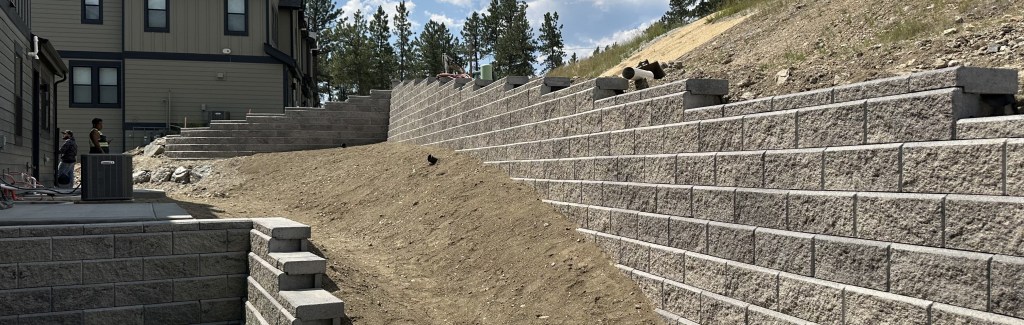
Segmental retaining walls (SRWs) are modular block retaining systems constructed from interlocking concrete units that rely on their mass, geometry, and in many cases geosynthetic reinforcement to retain soil and resist lateral earth pressures. SRWs are dry stacked, meaning they are built without mortar, which allows for controlled flexibility, drainage, and long term durability in a wide range of site conditions. They are commonly used for grade changes, landscaping, roadway embankments, commercial developments, and residential construction due to their versatility, aesthetic options, and cost effectiveness. Proper design considers soil properties, drainage, wall geometry, surcharge loads, and long term performance, making SRWs a reliable solution for both structural and aesthetic retaining applications.
The following details are for dry cast segmental retaining wall blocks constructed as gravity, MSE, and composite structures:
(Details Coming Soon, Check Back Later)
Big Block PMBW
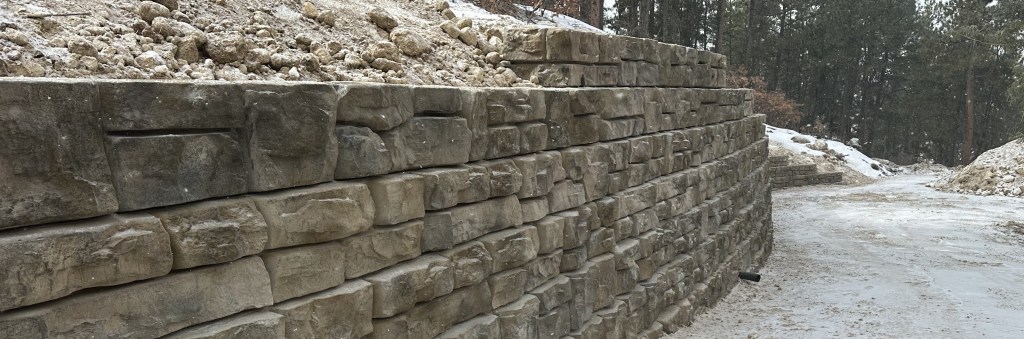
Precast modular block walls (PMBWs) are large format retaining wall systems constructed from engineered wet cast concrete units designed to provide high mass, structural reliability, and efficient installation on sites requiring significant grade changes. Unlike segmental retaining walls, which use smaller dry cast units, PMBWs utilize substantially larger blocks that can weigh hundreds to thousands of pounds and are typically installed with heavy equipment. The wet cast manufacturing process produces higher strength concrete, improved durability, and tighter dimensional tolerances compared to dry cast SRW units. PMBWs are commonly used for tall retaining structures, roadway embankments, commercial developments, and sites with limited space for geogrid reinforcement. Their large size, higher unit weight, and ability to function as gravity, MSE, or hybrid systems make PMBWs well suited for demanding structural applications where additional mass or reduced reinforcement length is required.
The following details are for wet cast precast modular block retaining wall units constructed as gravity, MSE, and composite structures:
(Details Coming Soon, Check Back Later)
Geotechnical
Common details used in geotechnical engineering and site development provide standardized guidance for the construction of earthwork, drainage, foundations, retaining systems, and site stability features. These details typically illustrate elements such as subgrade preparation, soil reinforcement, compaction requirements, drainage layers, utility bedding, erosion control measures, and typical sections for slopes, channels, and structural fills. They help ensure consistency in construction, reduce uncertainty for contractors, and clarify expectations for material quality and installation procedures. While these details serve as useful references, actual site conditions vary widely, and final design must always be based on project specific geotechnical data, engineering judgment, and applicable codes.
The following details represent common practices within the industry and should be adapted to the conditions, constraints, and design requirements of each individual site:
(Details Coming Soon, Check Back Later)
 Soil Structures Engineering